Friday, August 21, 2015

History of Monvesia: Elder Ages

ybe = years before the [Divine Drajan] Empire
ye = year of the [Divine Drajan] Empire
The most likely "universal" date count.
ybk = years before the Kleimland
yk = year of the Kleimland
The dates as counted during my original campaign.
Human history begins with the fall of Prosperity The Elder Ages were a time of Legend--history and mythology are blended.  Dates are not exact, though a rough progression of events can be understood.

First Age / Spiritual Age

Over 3,000 ybe (Over 4,000 ybk)

  • As the giant races near extinction at the hands of the HMDJVNW they choose six humans--the sons of Honsu/Golai--to carry on their legacy as the patriarchs of the goliaths
  • By the end of the Giant-HMDJVNW War, the land of Prosperity has been transformed into the land of Desolation.
  • The HMDJVNW enslave the human and goliath races by psychological and emotional means.  They create the Taint to prevent human and goliath cultures from developing enough to become a threat--creating orcs and ogres.
  • Last of the serpent-folk dynasties of the Scalykind Empire; first of the lizardfolk dynasties.
  • Dwarven expansion leads to the second dwarven schism, establishing the duergar and korobokuru subraces.

Wednesday, August 19, 2015

Legendary Monvesians: The Akhnaphar

In the orcish langauges, akhnaphar roughly translates as "three [of the] north," commonly understood as the Northern Triad.  When Jostin and Ignatius had first ascended, a small cult formed in the mountains who worshiped the Triad.  Independent veneration of Jostin and Ignatius overshadowed the first iteration of the Triad, however.  It wasn't until this ult and Gygar were redisovered that the Triad came to be venerated together again.

All three of the saints who are commonly venerated in the Kleimland were legendary heroes who ascended to sainthood.  While Gygar, Ignatius, and Jostin comprise the Akhnaphar itself, their stories, are bound with "anti-saints"--who ascended in opposition to the Triad--as well.

Gygar

Race:  Human (Honderreicher)
Class:  Wizard (Enchanter)
Background:  Noble
Temperament:  Idealist
Saintly Path:  Thaumaturge
Saintly Patron:   Mekare the Archivist
Sphere of Ascension:  Aerosphere
Venerated by:  Reorganized Disciples of Gygar (Order of the Northern Triad), Universal Order of Spiritual Thought

Born during the close of the Orc Wars, Gygar was drawn to magic as a way to protect those closest to him.  Using the powers he honed at the end of the war, he pursued the path of the thaumaturge under the tutelage of a dwarven Paragon.  While following this path, Gygar came to rule over the region of the river Kleim, calling his domain Gygaria.  He established himself as the strongest wizard in the land, and trained other arcanists. Among his students were:  Hippolyta, Novation, Ignatius, Ursula, Laurentis, Pascha, Constance and Christophe.

Saturday, August 15, 2015

Ascension in Monvesia, Part 3: Path

Once a character gains a sponsor, he must reach 20th level before setting off on the path to sainthood. The main principle that a petitioner must follow is to be true to his chosen Sphere, and to bring it glory and honor during the trials. Each path requires that a mortal pass five tough requirements:
  1. The character’s adventures must gain him a specific amount of experience. This amount is 36,000 XP for most characters but only 24,000 XP for the Path the Sphere favors. 
  2. The character must complete a new quest to retrieve an artifact from his sphere of power. The quest for this artifact should take several game years. 
  3. The character must successfully complete a trial of specific value to his class and the sphere (see below). 
  4. The character must prepare a testimonial to his greatness, a combination of followers and a lasting monument. Eighty percent of the character’s followers must be alive when he completes the path. The monument to his greatness must be financed by the character, and he must participate in its creation by either adventuring for components and manpower or by taking the risks of the actual physical construction. 
  5. The character must complete a specific monumental task that will benefit his sphere (see below for details). 
At the end of these steps, the character must return to the pilgrimage site and meet with the Saintly sponsor. If the character has failed to complete any of the steps, the Saint may set further requirements to be fulfilled before sainthood is granted. If all of the steps are completed, the Saint reviews the whims of chance. Roll 1d10. If a 1 is rolled, the petitioner has failed and is not granted immortality. He may request further tasks, or he may give up. If the petitioner is granted immortality, he may take a year and a day to complete his mortal affairs and then must leave the mortal realm to take one's place in the outer domains of the Spheres.

Wednesday, August 12, 2015

Ascension in Monvesia, Part 2: Sponsor

So, you've chosen the Saint that you would like to intercede on your behalf in the process of your Ascension.  Now what?  Well, you must ...
  1. ... prepare a gift for the Saint;
  2. ... make a pilgrimage to a holy site of the Saint's Sphere;
  3. ... make contact with the Saint; and
  4. ... petition the Saint to be your sponsor.
If successful, you will earn the right to proceed on your chosen Saintly Path.

Gift

The petitioner must create a gift of particular relevance to the Saint--relating in some way to their history, personality, etc. This gift should aesthetically represent and/or include the qualities of the Saint's Sphere (which will become the petitioner's Sphere, if successful). The more valuable the gift, the higher the chances for the character to receive a favorable response from the Immortal--generally, it should have a value greater than 25,000 gp.

Pilgrimage

Once the gift is prepared, the petitioner must make a pilgrimage to a place where a Saint of that Sphere may be contacted. This is usually a remote, hard to reach place with a reputation for dangerous hazards nearby. For example:
  • A tall mountain's peak (Aerosphere)
  • A secluded grove (Hydrosphere)
  • A primordial lava pool (Pyrosphere)
  • A forgotten tomb (Nerosphere)
  • A lost temple (Heirosphere)
  • An ore-rich cavern, untouched by miners (Lithosphere)

Monday, August 10, 2015

Ascension in Monvesia, Part 1: Basics

I had established early in the campaign that the local saints, Jostin and Ignatius, were one heroes who ascended to their place as venerable icons.  As the campaign advanced, I explored their mortal lives and hinted at their journey to immortality.  I had used the Immortal rules from Basic D&D to "explain" their ascension mechanically; and I wanted the players to realize that sainthood was something that they could aspire to as well, if they wanted.


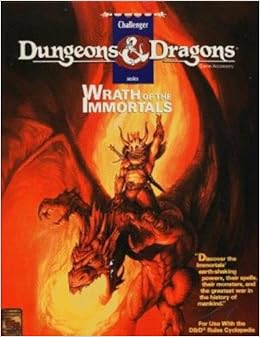
While the Immortals Set rules for Basic D&D explored life as a divine being, the rules for achieving immortality could be found in the earlier Masters Set, and were later reprinted in the Rules Cyclopedia. It is the latter rules that I would like to adapt to 5th edition.
Under the Pathfinder rules, I had planned on using Mythic Adventures to fill this purpose--but the campaign did not venture far enough for that to come up.  That ruleset has informed this adaptation as well.
Nearly every race is capable of achieving sainthood.  For most, the process is commonly called ascension--explicitly following the rules presented here.  For "otherworldly races" (such as elves, tiefling, and the like), the process is called transcendence.  While transcendence has the same outcome as ascension, its process is somewhat modified.

Saturday, August 8, 2015

Creatures NOT of Monvesia

In "Other Races in Monvesia," I briefly touch on player character races that do not [currently] exist in the campaign setting.  While some of those were ruled out completely, others were reserved for speculative purposes.  The difference between does not exist and will never exist is fuzzy--after all, halflings came to be an important part of the setting, when I had first ruled them out as over-used; similarly, half-orcs have also since found a home here.  Nevertheless, there remain some aspects of traditional fantasy gaming that I have continued to avoid.

Having already learned to avoid saying never in Monvesia, my aversion to certain elements can still be rated:
  • Aversion Level:  0 - This is an element of fantasy gaming that I think may have a fit in Monvesia, but I have yet to fully incorporate it.  There may not be a need for this element in the world--but I reserve the right to introduce it at a later date.
  • Aversion Level: 1 - This is an element of fantasy gaming that I often enjoy, but I do  not think it has a natural place in Monvesia
  • Aversion Level: 2 - This is an element of fantasy gaming that I think is overused, and would like to avoid using in Monvesia
  • Aversion Level: 3 - This is an element of fantasy gaming that is hand-crafted for another game world, and/or has developed a very particular, expected culture that does not fit in Monvesia.  Such elements would require an amount of work to untangle that may not be worth the time {ex. Drow}
  • Aversion Level: 4 - This is an element of fantasy gaming that is poorly conceived and/or wholly redundant.

Thursday, August 6, 2015

Character Concept & Party Bonding

"You wake up and find yourself in a cell with three strangers.  The last thing you remember is being attacked by a group of thugs ..."
"The bartender tells you that the hooded man at the corner table is looking for a few good adventurers.  It looks like three others have already found their way to his table.  He noties you looking, and beckons you over ..."
"As a member of the local adventurer's guild, you have been given an assignment to work with three other apprentices ..."
Just throw the party together on the first day, and they'll get along fine--each with his or her own agenda, each optimized to survive alone.  If the party doesn't get along, you penalize the players for not acting like a team.  Except, they aren't a team--they just met, and know nothing about each other.  While I have often use this method in the past, I would like to repent of my ways and move on.

The system presented in FATE is a great way of not only conceptualizing characters, but also unifying a party.  So, I figured I would adapt something like it as "Step Zero" in the character creations process in my games of 5th edition.  To do this correctly, the entire player party should be present without having yet created characters.  Players should have an idea of what they want their characters to be, but should not have put anything to paper yet.  For the party to be cohesive, every element should be fleshed out together.