Monday, July 22, 2019

SPORE: BIO-E For Everyone!

Anyone who has tried to play the mutant animal rules from Teenage Mutant Ninja Turtles and Other Strangeness in Heroes Unlimited knows that there is a major power imbalance between those mutant animals and the other power categories.  This was somewhat alleviated in that game's second edition successor, After the Bomb--but I play revised-era Palladium rules (mostly out of preference, though partly for financial reasons).  So, I have come up with my own solution:  Give all characters BIO-E, mutant or not.

This method changes the way BIO-E is used, but not what it represents.  BIO-E is still used to purchase humanoid traits, natural weapons and armor, animal powers, and animal psionics.  It is also used to purchase any attribute modifiers associated with a given animal type.
Many of the house rules I use for the SPORE settings are drastic variations on the originals; what follows is a simplification of concept copatible with revised-era palladium rules as published.  Details used in my LegacySPORE campaign will be different because of other rules changes.

Starting BIO-E

The average human can be described in mutant animal terms as follows:
  • Size level 10, 45 BIO-E
  • No attribute modifiers, 0 BIO-E
  • Full human biped, 10 BIO-E
  • Full human hands, 10 BIO-E
  • Full human looks, 10 BIO-E
  • Full human speech, 10 BIO-E
  • No natural weapons or armor, 0 BIO-E
  • No animal powers, 0 BIO-E
  • No animal psionics, 0 BIO-E
  • Base Animal BIO-E:  85

Thursday, July 11, 2019

Legacies of Eternity

There are events in history so important that they continue to continue to shape reality long after their circumstances have passed.  On the Plane of Time, these histories have taken on a life of their own; they have become conscious and stared to govern the actions of that Plane.  These Legacies have become the archdaemons of Eternity.  Their influence can be seen throughout time, whether the events that define them occured in the past, the present, or the future.  Since all things occur simultaneously on this plane, the Legacies are always active.

Sometimes, Legacies are called the horsemen of the apocalypse--harbingers of the End of Time.  This is both true and preposterous.  This is true in that when all Legacies have come to pass, that the end of the known world will be nigh.  Likewise, there can be no end to time; it will ever flow onward--there can be only change.
NOTE:  Legacies are always spoken of with the definine article:  the Titanomachy, the Exodus, the Deluge, etc.  In a way, these archdaemons only have epithets, and not true names.
Warlocks with Legacy patrons may use the homebrew Horologius patron until such time as an appropriate "official" option is released.

Legacies of the Past

These Legacies' effects on the Mortal Plane were experienced and understood in history, but continue to have lasing effects.


The Titanomachy

The conflict between the HMDJVNW and the giants of Raviq lasted for centuries.  During its course, the giant races were decimated, and their remnants ultimately exiled from Orbimond; their legacy was carried on in the goliath races.  The land of Prosperity was even physically transformed into the land of Desolation, and the Taint was unleashed upon the mortal races of he world.  Had the HMDJVNW not arrived in the mortal world, however, the war of the giants would still have occurred--instead against the might of the dragons!

The Titanomachy is the archdaemon of the giants (though giants do not dwell in Eternity).

Friday, July 5, 2019

Elves and Orcs of Tirol

I recently introduced my take on the amazon race in order to accommodate the Praxians of The Sentinels.  This allows me to keep all of the elvish subraces for the Tirolean peoples. Paired with the orc races, the Tiroleans and Zentraedi can be accommodated in a fantasy setting.

A triumvirate of former high elves.

Elves

Tirolean culture is classist, and has existed in this way for millennia.  Over time, several sub-races emerged as differen parts of the population became specialized in different roles.  The core elf sub-races map to Tirolean culture as follows:

High Elves are the urbanites of Tiresia--nobles, merchants, and artisans who often take on leadership roles in the community.  The majority of the founders of the Artifice Masters were of this race.  [Cabell, Zor]

Wood Elves can be found living in he wilderness of the large island of Tirol.  Because of their experiences with hunting and exploration, wood elves are more martially inclined than high elves, so often find themselves in military roles.  The military forces of the Artifice Masters are primarily wood elves.

Sunday, June 30, 2019

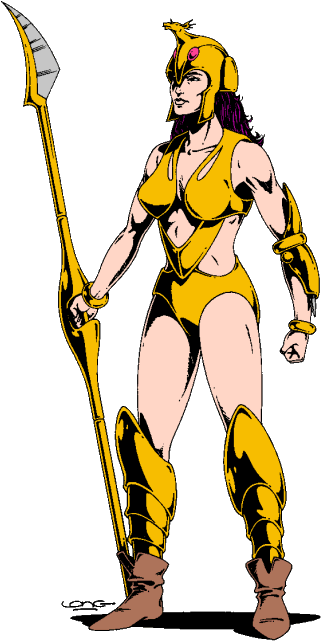
Amazons (D&D 5th)

Several homebrewers have tried their hands at creating an amazon race for 5th edition D&D.  None of which quite matched my need.  Below, I make my own attempt. 

This race was originally intended for the Artifice Saga campaign, but was designed to apply to other amazonian peoples of other campaigns.  It was not my intent to create new player races for all of the Sentinel peoples, only those for which a good analog is not quite available.  Tashas's Cauldron of Everything has since offered a new way of looking at new/uprepresented races/lineages.

Image result for praxian

Amazons

Amazons are a race of warrior women, known for their great strength and skill at war.  Sometimes stereotyped as haters (or even killers) of men, this is an extreme point of view.  Their society is unisex, however--and no man of any race is permitted to live among the amazons or marry one of their number (see Gargareans, below).

Saturday, June 29, 2019

Halflings of Prace, Henjal, & the Crown

RECTON NOTE: This posts revises and replaces "Halflings of Monvesia."  Much of the lore of Halflings has been updated.
-----
Language Analog: Basque
Inspiration:  Hobbits from the Tolkien Legendarium, Kender from Dragonlance (vaguely)
-----

Tainted Counterpart: none
Temperamental Association: Altruism

Names:  See Basque Names.

The first halflings were encountered in Prace over 100 years ago.  Based on their susceptibility to nipweed, it was assumed that they were distantly related to rakasta.  This assumption would later lead to a belief that halflings were un-tainted boggarts--a goblin-like creature often found associating with gnolls.  If this were the case, then halflings would have been the only species to have cured themselves from the Taint--after separating from their tainted parent race.  Experiments on this possibility, howevever, proved fruitless.
RETCON NOTE:  Boggarts are nothing more than juvenile gnolls.

Wednesday, June 26, 2019

5th Edition Cattlefolk

Minotaur has become a catchall term for "cattlle-folk" in modern gaming:  anthropomorphic races resembling bovidae (cows, sheep, goats, gazelles, buffalo, etc.) or other ungulates.  The term comes from Greek mythology, and literally means "bull of Minos;" for this reason, I reserve it for bullfolk below.  Other names are similarly drawn from mythology.  

A staple of this growing trope is that both genders have horns--which is not uncommon among the natural species they represent.  For this reason, the generic name for each subrace is based on the common noun used for a male of the various species represented:  bullfolk, ramfolk, stagfolk, and buckfolk.

To play an alternate cattlefolk subrace, disregard the features identified below as being specific to the minotaur. Instead, apply the traits of your chosen subrace.


5th Edition Birdfolk

Four varieies of "birdfolk" have been presented in secondary and tertiary sources for 5th Edition D&D:  The aarakocra was presented as a playable race in the Elemental Evil Player's Companion; the kenku in Volo's Guide to Monsters; and the aven and siren in two installments of Plane Shift (Amonkhet and Ixalan, respectively).  From three of these--aarakockra, aven, and siren--a common base race can be extrapolated; the remaining details of each race can then become the various birdfolk sub-races.

There are two methods of determining base traits:  1) Use the aarakocra traits from Elemental Evil, but disregard the features identified below as being specific to the aarakocra subrace; 2) alternately, use the aven base traits as-is.  In either case, apply the traits of the desire sub-race to the chosen base traits.  All birdfolk in the same campaign should use the same base traits. The only real differences between the two are alignment and age.
Kenku are specifically excluded from the birdfolk below.  Unlike aarakocra and aven, kenku are flightless--a feature core to the lore of the race.  Kenku should be treated as a unique race, related to other birdfolk as gnomes are [often] related to dwarves.